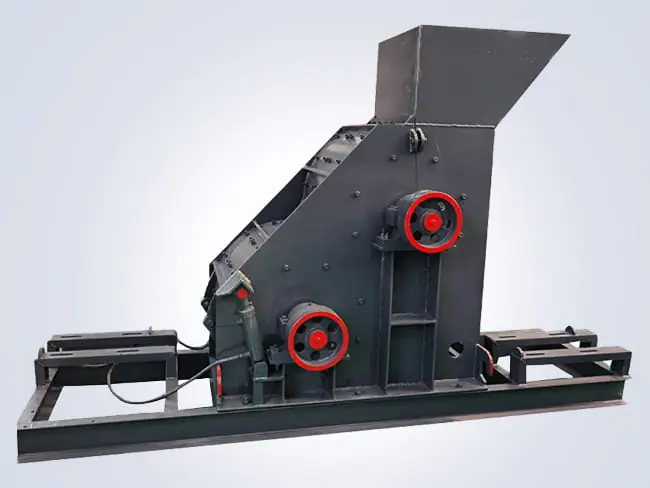
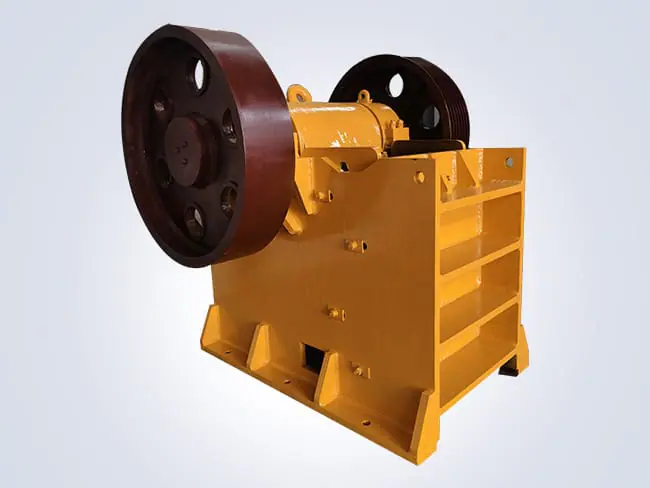
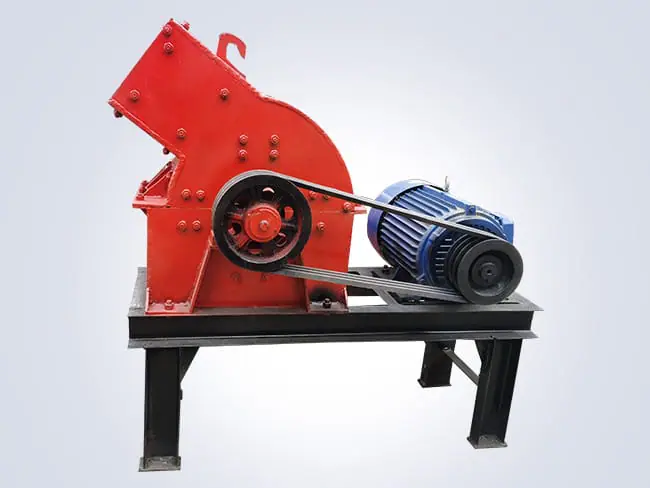
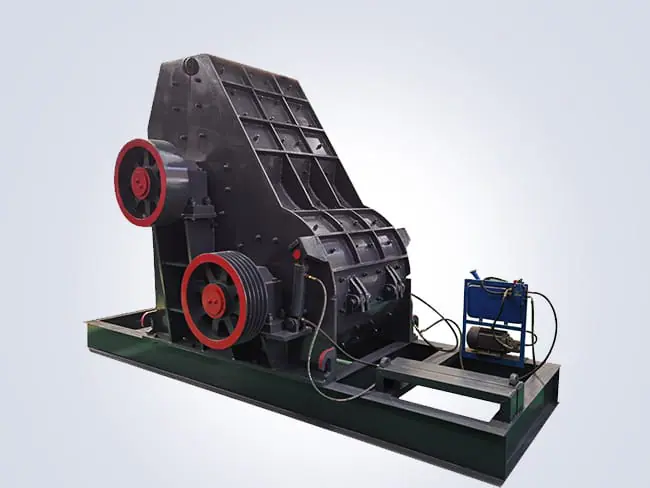
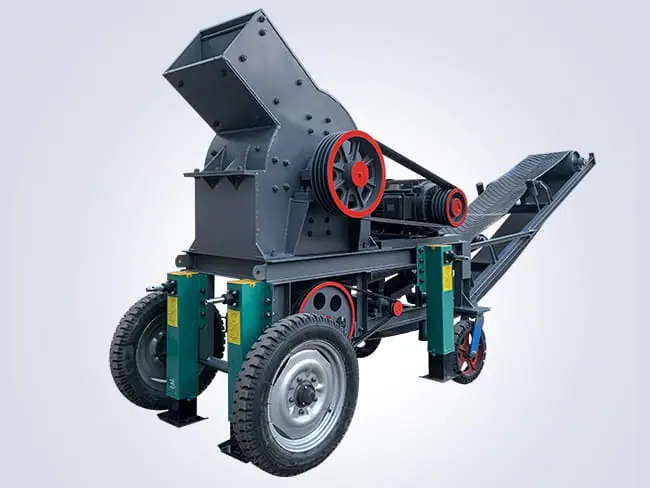
The hammer crusher is a core crushing equipment in industries such as mining, building materials, and chemicals. Utilizing the impact crushing principle, it achieves rapid material crushing. Due to its advantages of large crushing ratio, good forming effect, and simple operation, it has become the mainstream equipment in small and medium-sized material crushing production lines, widely used in processing medium-hardness brittle materials such as limestone, coal gangue, shale, and slag.
The core working principle of the hammer crusher is high-speed impact crushing. During operation, the motor drives the rotor to rotate at high speed. The alloy hammers evenly mounted on the rotor move in a circular motion with the rotor. Material entering the crushing chamber is instantly crushed along its own texture and weak structures such as cracks under the violent impact of the high-speed hammers. The crushed material collides and compresses with each other, further refining the particle size. Material that meets the specifications is discharged through the gaps in the bottom grate, while oversized particles remain in the crushing chamber for continuous impact and grinding until they reach the discharge standard. It can complete the fine crushing of large materials in one pass, simplifying the production process.
In terms of structural design, the hammer crusher combines practicality and stability. The equipment mainly consists of core components such as the machine body, rotor, hammers, grate bars, and transmission device. The overall structure is compact and occupies a small area. The core wear-resistant hammers are made of high-chromium alloy wear-resistant material, offering impact resistance and wear resistance, significantly extending service life. The split-type machine body, equipped with a hydraulic opening device, facilitates equipment maintenance, component replacement, and internal cleaning. Simultaneously, the equipment adopts a fully sealed structure, effectively suppressing dust leakage during the crushing process, improving the working environment, and meeting industrial environmental protection production requirements.
Compared to traditional crushing equipment, hammer crushers have significant advantages. First, they offer a large crushing ratio and uniform forming, capable of crushing millimeter-sized materials into particles smaller than 25 millimeters in a single pass, with controllable output particle size and well-formed finished particles. Second, they boast high production efficiency and strong adaptability, suitable for both dry and wet applications, adaptable to brittle materials with varying moisture content, and a wide range of hourly production capacities, meeting the needs of small and medium-sized production lines. Third, they have low operating and maintenance costs, a low equipment failure rate, and simple operation, requiring no complex debugging, significantly reducing labor and maintenance inputs, resulting in substantial economic benefits.
Currently, hammer crushers have been deeply integrated into various industrial production scenarios. In the mining industry, they are used for fine ore crushing and tailings recovery; in the building materials industry, they serve the processing of cement and brick raw materials; and in the power and metallurgical industries, they are used for crushing and processing coal and slag, serving as key equipment for resource regeneration and material pretreatment.
In summary, hammer crushers, with their comprehensive advantages of high efficiency, energy saving, environmental protection, and durability, are suitable for the production needs of multiple industries. With the development of intelligent and green industries, and continuous optimization and upgrading of equipment, they will undoubtedly play an even more important role in material crushing, solid waste recycling, and other fields, contributing to improved quality and efficiency in industrial production and green development.